Your comments


Hello,
use View -> Show Sidebar. Then click the "Add Folder…" button in the sidebar.
Alternatively, use File -> Open (Cmd-O), navigate to a folder and click Open.
Hello,
Both the one-time purchase and the subscription for Textastic Pro support Family Sharing.
However, Family Sharing must be set up correctly for this to work:
If you’ve enabled Purchase Sharing under “Family” in the Settings app and “Share Purchases” is also enabled for your account, Family Sharing should work.
See https://support.apple.com/en-us/108774 for details on how to enable Purchase Sharing for your account.
Textastic Pro should then be automatically activated on devices that are part of the Apple Family. It’s important that a shared payment method is set up.
I can see similar problems when editing text files in OneDrive using the Runestone app:
- In Runestone, I opened a file from OneDrive
- I added a line
- Hit "Done" to close the file
- When I open the file again, my changes are not visible
In iA Writer, I also see changes disappearing, but the behavior is different than in Textastic and Runestone.
So it looks like Microsoft has a bug in their OneDrive file provider.
I just tried to reproduce the issue with OneDrive on my iPhone:
- Use "Open…" to open a text file from OneDrive
- Add text to the file
- Close the file
When I now open the file again from "Recent Files" in Textastic, the changes I made to the file are not there.
But, if I open the file again using the "Open…" command, the changes are there! Also, when I view the file in the OneDrive app, I can see the changes.
Can you please try to view the file in the OneDrive app or use "Open…" to open the file again?
This looks like a bug in the OneDrive file provider.
Also, there is a file version history on https://onedrive.live.com/ under "My Files" where you can restore previous versions of the file. See https://support.microsoft.com/en-us/office/restore-a-previous-version-of-a-file-stored-in-onedrive-159cad6d-d76e-4981-88ef-de6e96c93893
I'm hopeful that you can use that to restore your file in case using "Open…" again does not work.
TOML support has been added in Textastic 10.9.2 which was just released.
Textastic for Mac does support find in files.
See Edit > Find in Files… or Cmd-Shift-F.
I'll consider adding TOML as a built-in language in a future update.
You can add custom syntax definitions to Textastic by using TextMate bundles or Sublime Text packages. See
https://www.textasticapp.com/v10/manual/customization/custom_syntax_themes_templates.html
A quick search for "TOML sublime text" on Google brought up this Sublime Text package which I just tried out and which seems to work fine with Textastic:
https://github.com/jasonwilliams/sublime_toml_highlighting
Please try the following:
- Go to https://github.com/jasonwilliams/sublime_toml_highlighting in Safari on your iPad/iPhone
- Tap the green "Code" button and select "Download ZIP"
- Unzip the file in the Files app. This will create a folder that contains the sublime package files. (Optionally you can rename this folder to "TOML")
- Move or copy that folder into the folder "On my iPad/Textastic/#Textastic/". This is equivalent to this folder in Textastic: "Local Files/#Textastic/".
- In Textastic, go to Settings -> Other and tap "Reload Customizations"
You can now select "TOML" from the list of syntax definitions in the File Properties.
Please note that this is a third-party syntax definition, not officially maintained by Textastic.
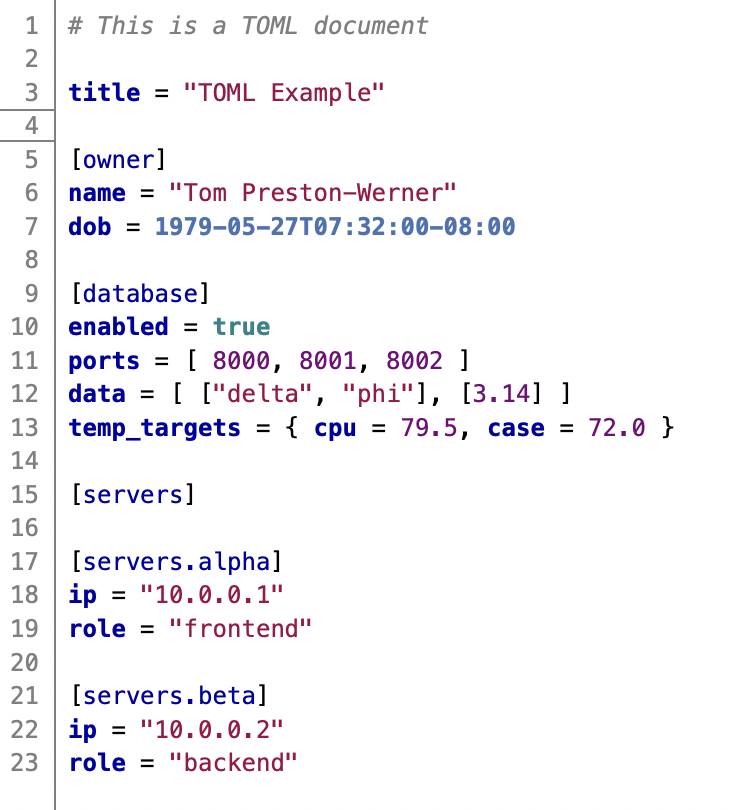
Here is a screenshot of how this looks in Textastic with a sample TOML document and the Vintage theme:
Customer support service by UserEcho